“Oh, my love, my darling…” — few opening lines in popular music carry such aching vulnerability or instant recognition.
Although most listeners associate “Unchained Melody” with The Righteous Brothers, the song was originally written in 1955 by Alex North (music) and Hy Zaret (lyrics) for the prison drama Unchained. Over the decades, it has been recorded by hundreds of artists, but the 1965 version by The Righteous Brothers, featuring the unforgettable lead vocal of Bobby Hatfield, transformed it into one of the most enduring love songs in modern music history.
Produced by Phil Spector, the recording carries elements of his signature “Wall of Sound” approach — rich orchestration, echoing depth, and dramatic build. Yet unlike some of Spector’s denser productions, this arrangement leaves space for the vocal performance to breathe. And it is Hatfield’s voice — tender, restrained, then soaring — that defines the track’s emotional power.
A Ballad That Defied Its Era
By 1965, popular music was rapidly evolving. The British Invasion dominated charts. Rock bands were louder, sharper, more youth-driven. In contrast, “Unchained Melody” felt timeless rather than trendy. Its slow tempo and orchestral sweep stood apart from the electric surge of the moment.
The lyrics revolve around longing, separation, and hope. There is no complex storyline — just emotional escalation. Each verse builds gently toward the chorus, and then toward that legendary high note near the end. That sustained climax remains one of the most celebrated vocal moments in pop ballad history.
The single reached the Top 10 on the Billboard Hot 100 in 1965, solidifying The Righteous Brothers’ place in the American pop canon. But the song’s journey was far from over.
The 1990 Revival: “Ghost” and Global Resurgence
In 1990, the romantic fantasy film Ghost, starring Patrick Swayze and Demi Moore, introduced “Unchained Melody” to a new generation. The iconic pottery wheel scene permanently linked the song to cinematic romance. Following the film’s success, the 1965 recording was reissued and once again climbed international charts — an extraordinary comeback 25 years after its original release.
Few songs manage to dominate two completely different decades. Even fewer retain their emotional authenticity across them.
Since then, “Unchained Melody” has become a staple in:
- Ghost (1990) — The defining modern association of the song.
- The Simpsons — Referenced and parodied as shorthand for sweeping romance.
- Family Guy — Used for comedic exaggeration of melodrama.
- American Idol — Frequently performed due to its vocal range and emotional intensity.
The track has also appeared in wedding scenes, romantic montages, and television retrospectives, reinforcing its reputation as one of the most powerful love ballads ever recorded.
Elvis Presley and “Unchained Melody”
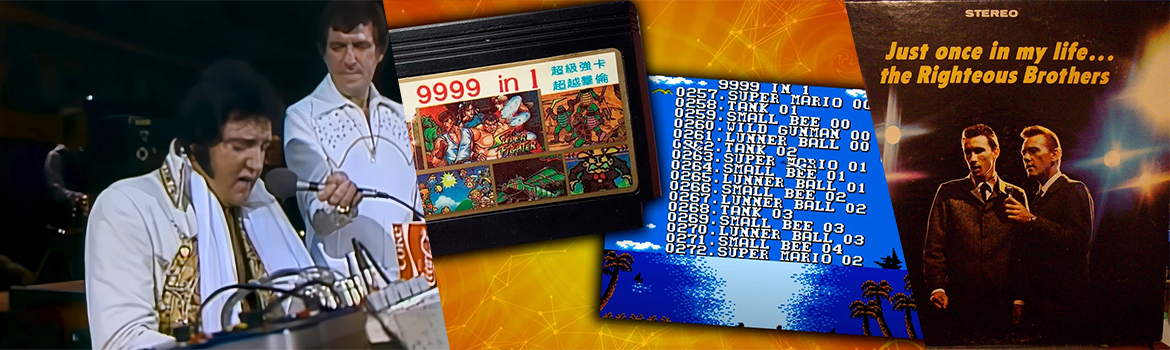
Elvis Presley performed “Unchained Melody” live during his final concert tour in 1977, just a few weeks before his death. One of the most remembered performances took place on June 21, 1977, in Rapid City, South Dakota, where he delivered the song with raw emotion at the Rushmore Plaza Civic Center — a show later filmed for the TV special Elvis in Concert.
Another notable live rendition was recorded April 24, 1977, in Ann Arbor, Michigan, and this version was included on his last album Moody Blue.
The Unexpected Turn: The 8-bit NES-style version
In the early 1990s, unofficial NES multicarts appeared across Eastern Europe and the post-Soviet space, including Famiclone and Dendy systems. Many of these pirated cartridges featured several games — and an 8-bit version of “Unchained Melody” looping in the menu soundtrack. The carts were unofficial, often labeled with names like “10000000-in-1” or “9999-in-1”, and were sold alongside the consoles.
The earliest known multicarts of this type date back to 1992, meaning the NES-style rendition of the song emerged during the height of Dendy and Famiclone popularity. These compilations usually contained only a few playable games, while the menu music — in some cases “Unchained Melody” — played continuously as users navigated between titles.
It should be noted that these versions were not officially released by Nintendo or the song’s copyright holders. Created as pirated compilations, they nevertheless became a cultural phenomenon for those who grew up with these consoles, blending retro gaming hardware with a timeless pop ballad in a way that remains unforgettable.
Why It Endures
The secret of “Unchained Melody” lies in universality. Its themes — distance, yearning, devotion — are not tied to one decade. Its structure allows for reinterpretation across genres and technologies. From 1950s cinema to 1960s radio dominance, from 1990s blockbuster revival to 8-bit nostalgia culture, the song continues to evolve without losing identity.
In an era defined by short attention spans and algorithm-driven hits, the track’s slow pacing feels almost radical. It asks listeners to sit with emotion rather than scroll past it.
And perhaps that is why it continues to resonate.
Conclusion: A Melody Beyond Format
“Unchained Melody” by The Righteous Brothers is more than a chart success from 1965. It is a cross-generational cultural artifact. From its original film roots to its legendary performance in Ghost, and even to its reinterpretation in 8-bit digital form, the song has proven that true melody transcends medium.
“I need your love…”
Whether carried by a full orchestra, a soaring tenor voice, or the electronic pulse of a retro console, the emotion remains intact.
Some songs belong to a moment.
“Unchained Melody” belongs to every era that rediscovers it.