“I get knocked down, but I get up again.”
Few choruses in modern pop history have been as instantly recognizable — or as stubbornly immortal — as this one.
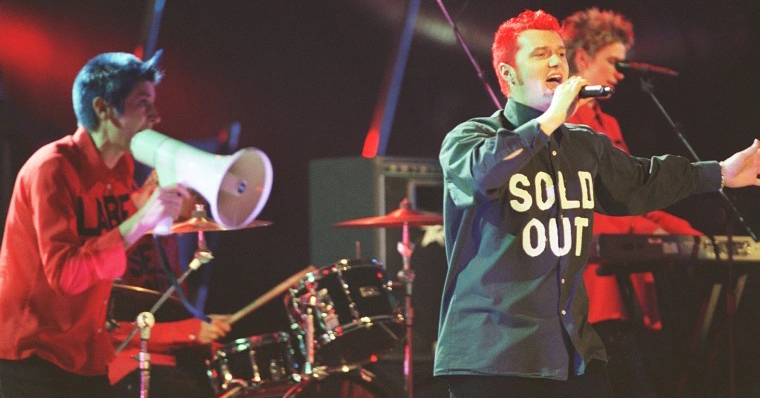
Released in 1997, “Tubthumping” became the defining hit of British band Chumbawamba, taken from their eighth studio album, Tubthumper. Produced by Chumbawamba alongside Neil Ferguson, the track marked a dramatic shift from the group’s earlier anarcho-punk roots toward a bold fusion of alternative rock, dance-pop rhythms, and pub-chant folk energy. What could have been a one-season radio hit instead evolved into one of the most persistent cultural anthems of the late 20th century.
Musically, the song is deceptively simple. A pounding four-on-the-floor beat. Layered gang vocals. A chorus built for stadium repetition. Yet beneath its chant-along structure lies a clever construction: verses listing different drinks as metaphors for coping and camaraderie, culminating in a communal declaration of resilience. It feels rowdy. It feels ironic. It feels triumphant.
And that tension is key.
Chumbawamba were not manufactured pop opportunists. They emerged from the UK’s anarchist punk scene, known for political activism and anti-establishment messaging. When “Tubthumping” exploded globally, reaching the Top 10 in multiple countries and peaking at No. 6 on the Billboard Hot 100, it created a fascinating paradox: an underground collective suddenly delivering one of the most commercially successful singles of 1997.
The late 90s were defined by genre-blending experimentation — alternative rock meeting electronic production, Britpop confidence colliding with global dance culture. “Tubthumping” fit perfectly into that moment. It was rebellious but accessible. Playful but defiant. Commercial, yet strangely subversive.
Above all, it was universal.
The message wasn’t complicated. It didn’t need to be. Resilience never goes out of style.
Film, TV & Cultural Appearances
Over the years, “Tubthumping” has become shorthand for comeback energy, chaotic celebration, and 90s nostalgia. Its media footprint is extensive, stretching across decades.
Saturday Night Live (1975– ) — Referenced and used in sketches, often leaning into its chant-driven absurdity.
The Simpsons (1989– ) — Appears as a cultural callback, reinforcing its late-90s ubiquity.
Beverly Hills, 90210 (1990–2000) — Used during party-driven sequences reflecting youth culture at its peak.
The Challenge (1998– ) — Functions naturally as a competitive comeback anthem.
Dawson’s Creek (1998–2003) — Amplifies emotional momentum in youth-centered storytelling.
Family Guy (1999– ) — Played for comedic exaggeration, capitalizing on its instantly recognizable hook.
Malcolm in the Middle (2000–2006) — Mirrors the show’s chaotic, high-energy tone.
How I Met Your Mother (2005–2014) — Used to trigger nostalgic 90s references and group camaraderie.
Chuck (2007–2012) — Blends seamlessly with action-comedy pacing.
Being Erica (2009–2011) — Reinforces themes of second chances and personal resilience.
Superstore (2015–2021) — Adds ironic momentum to workplace comedy moments.
Love Island (2015– ) — Used in celebratory montage sequences.
Scream Queens (2015–2016) — Heightens exaggerated camp energy.
The Crown (2016– ) — Grounds late-90s timeline sequences with era-authentic sound.
No Tomorrow (2016–2017) — Echoes its live-for-the-moment philosophy.
MacGyver (2016–2021) — Underscores action sequences with motivational undertones.
Billions (2016–2023) — Aligns with power struggles and defiant character arcs.
The A Word (2016–2020) — Appears within emotionally layered narrative context.
Doom Patrol (2019–2023) — Embraces the song’s anarchic undertones.
Good Trouble (2019– ) — Reinforces persistence in socially conscious storytelling.
Little Fires Everywhere (2020) — Adds nostalgic texture to dramatic tension.
Ghosts (2021– ) — Used for tonal contrast and comedic rhythm.
Who Killed Sara? (2021–2022) — Creates deliberate contrast between upbeat rhythm and darker narrative elements.
Big Nate (2022– ) — Introduces the anthem to a younger animated audience.
Nobody Wants This (2024) — Confirms the track’s continued relevance in the streaming era.
Each appearance reinforces the same core idea: this song communicates determination instantly. No exposition required. One chorus — and the emotional tone is set.
More Than a One-Hit Wonder
Despite often being labeled a “one-hit wonder,” Chumbawamba maintained a long and politically engaged career, ultimately disbanding in 2012. Ironically, the massive commercial success of “Tubthumping” allowed the band to fund activist projects and amplify social causes — a rare case of mainstream triumph feeding underground values.
But culturally, the song took on a life of its own.
It became a sports anthem. A meme. A karaoke staple. A punchline. A motivational chant. A nostalgic trigger for anyone who lived through the late 1990s.
Few tracks achieve that level of adaptability.
Conclusion
Nearly three decades after its release, “Tubthumping” by Chumbawamba still resurfaces in television, competition shows, streaming series, and cultural retrospectives. Its simplicity is its strength. Its repetition is its power.
It is motivational without being sentimental. Ironic without being cynical. Loud without being hollow.
“I get knocked down, but I get up again.”
That line no longer belongs only to the band. It belongs to pop culture itself.
And like the chorus promises, the song keeps getting knocked down — dismissed as kitsch, reduced to nostalgia — only to get up again, louder than before.
Some anthems belong to an era.
“Tubthumping” belongs to resilience.